

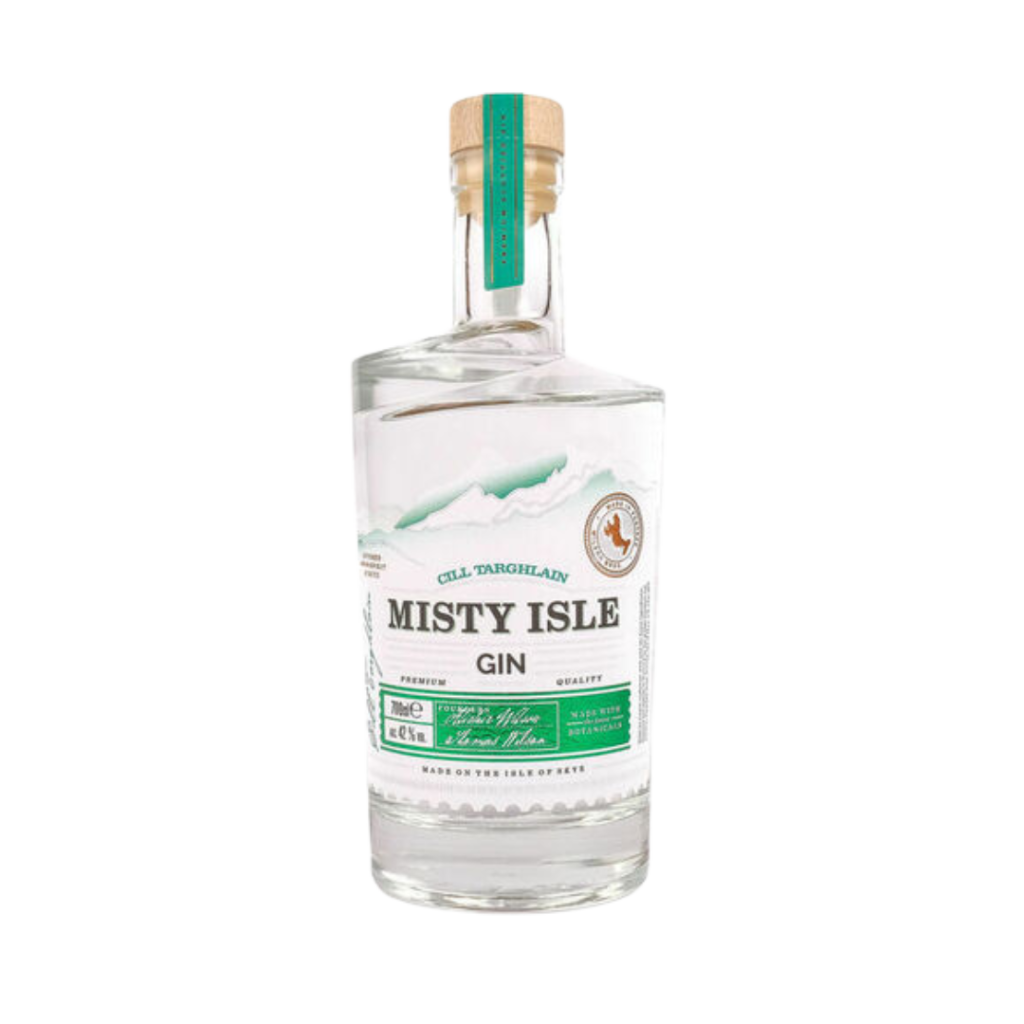

Some gins earn attention through bold marketing. Others earn it through a sense of place so distinct that the liquid itself feels like a document of where it came from. Misty Isle Cill Targhlain Gin belongs to the latter category. Produced on the Isle of Skye — one of Scotland’s most elemental and visually arresting landscapes — this is a gin shaped by its geography in ways that reward patient attention.
Background: Skye, the Distillery, and the Name
The Isle of Skye has long carried a certain mythic weight in the Scottish imagination. Its Gaelic name, often translated as the “Winged Isle,” conjures images of sea cliffs, heather moorland, and air that carries salt and peat in equal measure. It is, in every sense, a place with a flavour of its own.
Cill Targhlain — the name itself drawn from Gaelic, referring to a local area on the island — grounds this gin firmly in its home. Misty Isle Gin is produced at the Isle of Skye Distillers, a small-batch operation committed to capturing the character of its surroundings. The distillery draws on local water and locally sourced botanicals where possible, an approach that reflects a wider movement in Scottish craft distilling toward terroir-driven production. The name is not ornamental; it signals an intent to make something that could only have come from this particular corner of the Hebrides.
Botanicals and Flavour Profile
Misty Isle Cill Targhlain Gin is understood to feature a botanical selection that draws meaningfully from the island’s natural environment. Juniper forms the structural backbone, as it should in any well-considered gin, but it is accompanied by botanicals that are thought to reflect the coastal and highland character of Skye — including heather, local botanicals with an earthy or floral quality, and elements that suggest the maritime landscape surrounding the distillery.
On the nose, one might reasonably anticipate a gin that is measured rather than immediately assertive — a profile where juniper asserts itself cleanly, supported by what seems likely to be an understated floral quality and perhaps a suggestion of the sea. The palate, based on the distillery’s approach and regional character, is expected to carry a certain herbal depth alongside that juniper foundation, with any citrus or spice notes playing a supporting role rather than dominating the mid-palate. The finish is likely to be dry and pleasantly lingering, in keeping with the character of well-crafted Scottish gin.
What distinguishes gins of this kind — island-made, botanically grounded in place — is not necessarily the presence of dramatic or unusual flavours, but the coherence of the overall composition. Drinkers who appreciate that kind of measured sophistication may find Cill Targhlain a rewarding exploration. For a sense of how other geographically rooted Scottish gins approach this philosophy, 57° Skye Earth and Sea Gin offers an interesting point of comparison — another expression that draws its identity from the same island landscape.
How to Drink It
A gin with this degree of regional character is best served in a way that allows its botanical composition to remain audible. We suggest beginning with a simple gin and tonic, using a premium light tonic water — Fever-Tree Refreshingly Light or a similarly understated option — served in a copa glass over a generous measure of ice. A garnish of fresh heather, if available, would be a fitting complement; alternatively, a sliver of cucumber or a sprig of fresh thyme would work sympathetically with the likely herbal and floral notes.
For those who prefer their gin neat or over a single large ice cube, Cill Targhlain seems well-suited to that kind of contemplative drinking. A small measure served at room temperature first, to appreciate the nose, followed by a second pour over ice, is an approach we find genuinely useful when assessing any gin with strong regional ambitions.
In cocktails, a classic Martini — stirred, with a light vermouth — would allow the gin’s character to carry the drink. Those who enjoy a Negroni may find that the earthy and herbal elements of this gin create an intriguing dialogue with Campari and sweet vermouth, though the balance would be worth adjusting to taste.
Who Will Appreciate This Gin
Misty Isle Cill Targhlain Gin is likely to resonate with drinkers who find genuine pleasure in the idea of provenance — those for whom knowing where a spirit comes from, and why that matters, is part of the experience. It is not a gin designed for shock or novelty. It asks for a degree of attentiveness in return for what it offers.
Those who already appreciate the broader tradition of Scottish craft gin — particularly expressions that prioritise botanical coherence over individual fireworks — will find it worth exploring. Drinkers with an affinity for coastal or landscape-driven gin styles, such as Edinburgh Gin Seaside, may also find that Cill Targhlain speaks a similar language, though with a distinctly Hebridean accent.
Equally, this is a gin that rewards those new to craft Scottish gin who are curious about how geography can shape a spirit. It is not an intimidating bottle, and its apparent commitment to place over pretension makes it an approachable introduction to what island distilling can produce.
For those interested in exploring how other small-batch producers around the world approach terroir-driven botanical selection, Kinrara Distillery Artist Edition Ginny offers another compelling perspective from the Scottish Highlands.
A Brief Verdict
Misty Isle Cill Targhlain Gin is a considered and quietly ambitious expression of what the Isle of Skye has to offer the world of craft spirits. It wears its origins honestly and asks to be appreciated at a measured pace. For those drawn to gins with a genuine sense of place, it is a bottle worth seeking out.


