
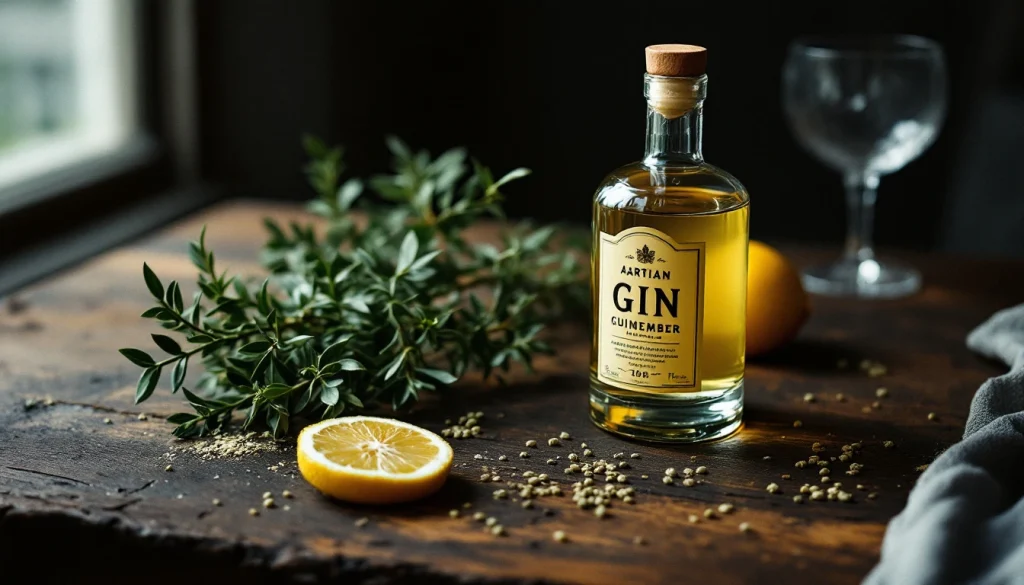


Not every gin announces itself loudly. Some earn attention through a quieter kind of confidence — a considered botanical bill, a clean distillation, and a name that carries a certain weight. G.H.Q. London Dry Gin is one such spirit. It is a gin that rewards a little curiosity, and it is worth taking the time to understand what it represents within the broader London Dry tradition.
Background: The Story Behind the Name
G.H.Q. — an abbreviation drawn from military parlance, referring to a General Headquarters — carries with it connotations of precision, command, and discipline. These are qualities that translate, perhaps more naturally than one might expect, into the craft of distilling. The name suggests an attention to structure and order, and the spirit itself appears to reflect that ethos.
The gin is produced in Scotland, a country whose distilling heritage is primarily associated with whisky but which has, over the past decade, cultivated a genuinely compelling gin landscape. Scottish distillers have demonstrated a particular aptitude for marrying traditional London Dry discipline with locally sourced or regionally inspired botanicals, and G.H.Q. follows in that tradition. While the distillery operates with relative modesty in terms of public profile, the gin has earned its place in the broader conversation around well-made British spirits.
Botanicals and Flavour Profile
As a London Dry Gin, G.H.Q. adheres to the legal and stylistic requirements of the category: all flavour must be derived during distillation, no artificial additives are permitted, and juniper is expected to lead. Within those parameters, the distiller has room to express a point of view — and G.H.Q. appears to take that responsibility seriously.
Juniper is present and properly foregrounded, as it should be in any gin bearing the London Dry designation. Beyond that, the botanical profile suggests a considered balance between classic supporting botanicals — coriander seed, angelica root, and citrus peel are likely contributors — and what seems to be a measured inclusion of more distinctive elements that lend the gin its particular character. Without access to the distillery’s full disclosure, we would be cautious about stating precise botanical counts, but the overall impression is of a gin that is structured without being austere, and approachable without sacrificing depth.
On the nose, one can reasonably expect the gin to lead with aromatic juniper and a clean, bright citrus lift — qualities that define well-executed London Dry production. The palate is likely to offer a measured spice note alongside the expected resinous pine, with a finish that is dry and relatively clean. For drinkers who have explored comparable expressions — such as Kunstwerk London Dry Gin or Greater Than London Dry Gin — G.H.Q. occupies a similar space: confident in its classicism, without resorting to novelty for its own sake.
The bottling strength is consistent with standard London Dry expressions, making it versatile across a range of serves without overwhelming the glass.
How to Drink It
A gin of this character rewards simplicity. The London Dry style exists, in part, to demonstrate what thoughtful distillation can achieve without embellishment, and G.H.Q. is best appreciated when the serve respects that intention.
Neat or on ice: If you wish to understand the gin on its own terms, a small measure served at room temperature or over a single large ice cube provides the clearest picture of the botanical architecture. A wide-mouthed glass — a Glencairn or a short tumbler — concentrates the aromatics usefully.
Gin and tonic: This remains the most instructive serve for a London Dry. We suggest a premium dry tonic — one that does not compete with the botanical profile — served in a copa glass over plenty of ice. A twist of lemon or a thin slice of cucumber works well as a garnish, amplifying the citrus and herbal notes without obscuring them. Avoid garnishes that are too assertive; this gin does not need assistance in that direction.
Classic cocktails: G.H.Q. is well suited to the Martini, where its dry character and clean finish can be properly appreciated. A ratio of three parts gin to one part dry vermouth, stirred with ice and served with a lemon twist, is a reliable approach. It would also perform admirably in a Negroni, where its juniper-forward profile holds its own against Campari and sweet vermouth.
We would exercise some caution with heavily sweetened or fruit-forward cocktails — not because the gin cannot manage them, but because they tend to diminish what makes a gin of this style worth exploring in the first place.
Who Will Appreciate This Gin
G.H.Q. London Dry Gin is, at its core, a gin for those who appreciate the category’s classical traditions. It is a spirit that rewards drinkers who have moved beyond novelty and arrived at a genuine interest in craft and technique.
Those who already appreciate well-structured London Dry expressions — and who find themselves returning to them for their reliability and depth — will likely find G.H.Q. worth exploring. It is also a thoughtful introduction for newer gin drinkers who are ready to move beyond heavily flavoured expressions and begin to understand what the London Dry style, at its best, is capable of.
Drinkers with an interest in Scottish craft spirits may find an additional layer of interest here, particularly if they have already explored the range of botanically inventive gins emerging from that country. The combination of London Dry discipline with a distinctly Scottish production context is not unusual — but when it is executed with care, as it appears to be here, the result is a gin that feels coherent and purposeful rather than derivative.
If you have appreciated other classically oriented expressions such as Artingstall’s Brilliant London Dry Gin, G.H.Q. belongs in the same conversation.
A Closing Verdict
G.H.Q. London Dry Gin presents itself as a gin of considered restraint — one that respects the traditions of its category while maintaining enough individuality to hold genuine interest. It is the kind of spirit that does not demand attention but repays it generously. For those who value structure, clarity, and the enduring appeal of a well-made London Dry, it is a bottle that deserves a place on the shelf.