
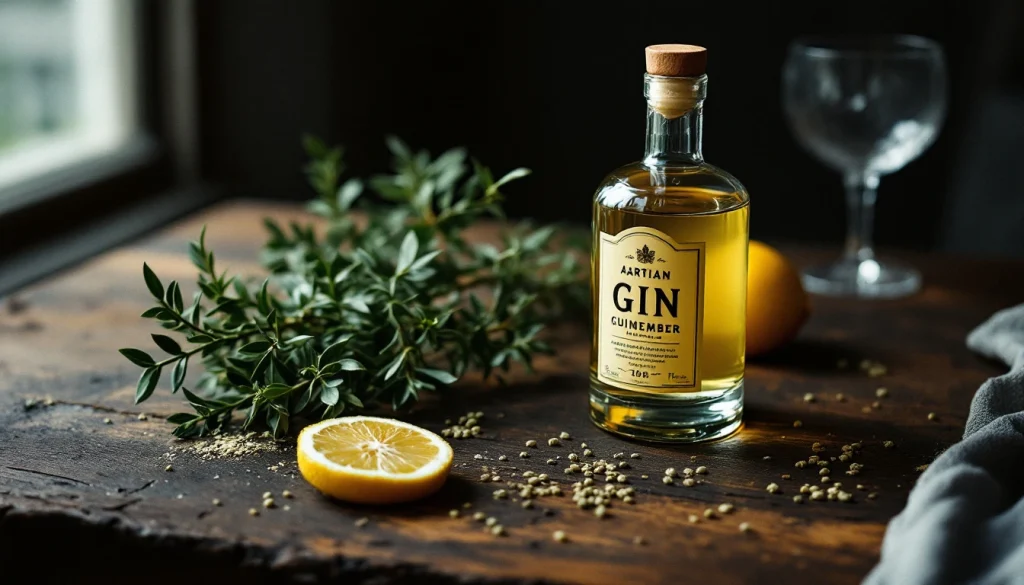



Not every gin announces itself loudly. Some are worth paying attention to precisely because of their restraint — the care taken in construction, the deliberateness of each decision. Kunstwerk, London Dry Gin belongs to that quieter category. The name itself — German for “work of art” — signals an intention: this is a gin conceived with craft at its centre, not spectacle.
For those who appreciate the London Dry style in its more considered expressions, Kunstwerk offers a compelling case study. It does not rely on novelty botanicals or vivid colour to earn attention. Instead, it asks to be evaluated on the terms that have always defined the category: balance, clarity, and the quality of what is in the glass.
Background: The Distillery and the Concept
Kunstwerk is a German gin, produced with the precision and compositional seriousness one might expect from that tradition. Germany has developed a quietly distinguished gin culture in recent years, producing spirits that tend toward structural clarity and botanical discipline rather than exuberance. Kunstwerk sits comfortably within that lineage, carrying both the rigour of its origins and the classical framing of the London Dry designation.
The London Dry classification is worth noting here. It is not merely a style marker — it is a legal commitment. No flavourings or sweeteners may be added after distillation, and the predominant flavour must be juniper. For a German producer to work within this framework is a deliberate artistic choice, one that speaks to a respect for gin’s foundational conventions even while bringing a distinctly Continental sensibility to the spirit.
Those curious about how German distilling compares to other European approaches may find it useful to explore gin from neighbouring traditions. Ginnlich Hamburg Dry Gin, for example, offers another perspective on how the Hamburg region interprets the dry gin form.
Botanicals and Flavour Profile
As is common with producers who take the craft seriously, the precise botanical recipe of Kunstwerk is not published in exhaustive detail. What we can observe from the spirit itself — and from what the producers have shared — suggests a botanical selection rooted in the London Dry canon: juniper at the fore, supported by what appears to be a considered arrangement of spice, citrus, and earthy root notes.
On the nose, the gin offers what we would describe as a composed, juniper-led opening with what may suggest coriander seed and a gentle citrus brightness beneath. There is an impression of cool, clean distillation — no rough edges, no single botanical pushing too insistently ahead of the others. The palette appears structured, leaning toward the drier end of the London Dry spectrum, with a finish that carries a measured warmth and lingering resinous quality.
We would be cautious about assigning precise tasting notes with absolute certainty — gin appreciation is, after all, a personal and contextual experience. What we can say with confidence is that Kunstwerk presents as a well-integrated spirit, one where the component parts appear to have been assembled with care for how they interact rather than how individually they perform.
Those who enjoy botanically intricate European expressions may also wish to explore Gin Balthazar, London Dry Gin, which offers its own interpretation of the style with a similarly composed character.
How to Drink It
A London Dry gin of this temperament is best served in ways that allow its botanical architecture to remain legible. We suggest the following approaches.
Neat or with a single large ice cube: For those who wish to understand the gin on its own terms, a small pour at room temperature or lightly chilled over a single piece of ice is instructive. A tulip-shaped glass or a copa will concentrate the aromatic qualities and reward a patient nosing.
Classic Gin and Tonic: A high-quality dry tonic — one that does not carry excessive sweetness — is the natural companion here. We suggest a ratio of one part gin to two parts tonic, served in a copa glass over generous ice. A strip of lemon peel, expressed over the glass and rested on the rim, provides a citrus lift that complements rather than competes with the botanical profile.
The Martini: A gin that leans dry and juniper-forward tends to perform with distinction in a Martini. Kunstwerk, by our estimation, is well worth exploring in this context. A three-to-one ratio of gin to dry vermouth, stirred over ice and strained into a chilled coupe, with a lemon twist, would be our suggested starting point. Those who prefer their Martini drier still may wish to adjust accordingly.
The Negroni: The structured character of a London Dry gin holds its own when combined with sweet vermouth and Campari. Kunstwerk should carry itself well in equal-parts proportions, stirred and served over a large ice cube in an Old Fashioned glass, garnished with an orange peel.
Who Will Appreciate This Gin
Kunstwerk is not a gin that announces itself to every drinker immediately. It rewards those who bring some familiarity with the London Dry style — who understand what juniper-led balance feels like, and who appreciate a spirit that earns respect through composition rather than novelty.
If you are drawn to gins that prioritise structural integrity over arresting innovation, Kunstwerk is worth your consideration. It sits alongside other thoughtfully constructed European expressions that understand the London Dry form as a discipline rather than a limitation.
Those who enjoy exploring how different producers interpret classical gin frameworks may also find value in looking at Ginificio Microdistillery, Ginuno, which approaches the craft from a similarly intentional Italian perspective.
New gin drinkers may find Kunstwerk most rewarding after some initial exploration of the broader London Dry category. It is not an inaccessible gin, but its pleasures are perhaps more apparent once one has a frame of reference for what the style can achieve at its most disciplined.
Verdict
Kunstwerk, London Dry Gin presents as a composed, juniper-led spirit that takes the conventions of its category seriously without becoming formulaic. The name carries a certain weight of intention, and on the evidence of what is in the bottle, that intention appears to have been met with care. For those who appreciate gin as a craft rather than a category, it merits a place on the shelf and time in the glass.